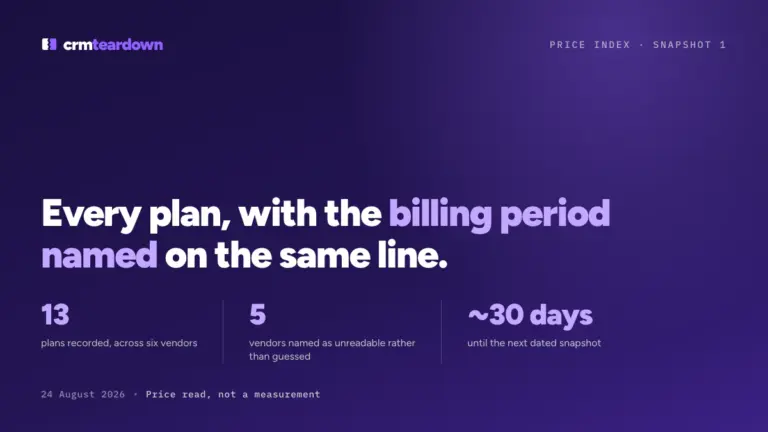
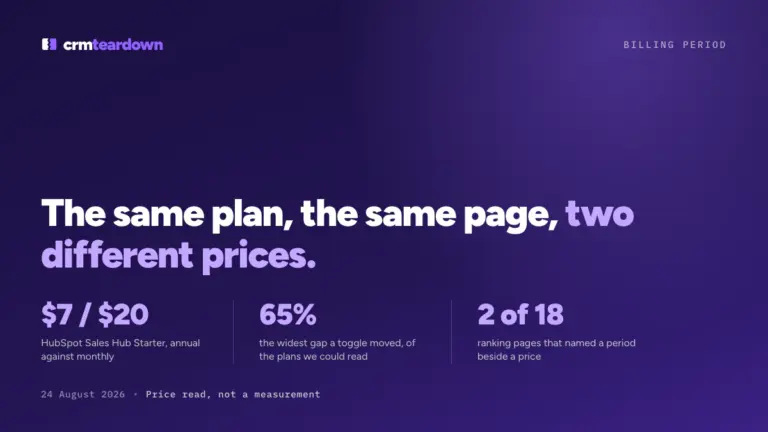
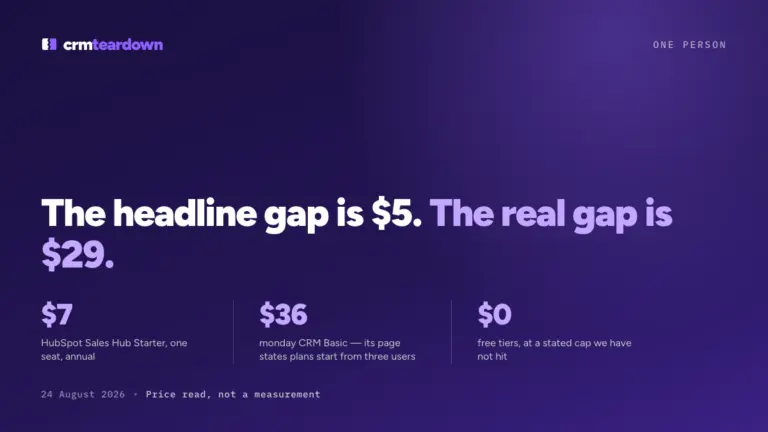
Multiplying a seat price by a headcount is arithmetic anyone can do, and it produces the wrong answer, because the tier that carries the cheap seat price usually cannot hold the database a ten-person or twenty-five-person team has. Prices read on 24 August 2026, a 25-seat team on EngageBay's Basic tier totals $318.50 a month. Give that same team 10,000 contacts and Basic's published 500-contact ceiling rules it out, Growth's 5,000 ceiling rules it out too, and the bill becomes $2,549.75 on Pro. Same vendor, same headcount, eight times the money, decided entirely by a number in a different column.
Checked on 24 August 2026. Every figure below was read that day on the vendor's own pricing page with the toggle switched both ways. Prices change without notice. Check the vendor's page before you buy.
Is this a test?
No. This is a price read plus arithmetic, not a measurement. No account was opened, no seat was bought and no invoice exists behind this page. Every total below is the vendor's published per-seat rate multiplied by a headcount, with the vendor's published seat minimum applied.
What does a CRM cost for 10 users?
On the entry tier of each product we could read on 24 August 2026, ten seats came to $70 a month at HubSpot Sales Hub Starter on annual commitment, $90 at Freshsales Growth, $120 at monday CRM Basic, $127.40 at EngageBay Basic on its two-year rate, and $350 at Close Essentials. Paying month to month rather than committing raises most of those substantially, and the entry tier is not necessarily a tier that fits your data.
That last clause is the whole page, and the second table below is where it bites.
The entry-tier bill at three headcounts
Read 24 August 2026. Monthly totals, computed as the published per-seat rate multiplied by the headcount. Close Solo is excluded because it is single user by definition, so Essentials is Close's first multi-seat plan.
| Vendor and entry plan | 3 seats | 10 seats | 25 seats | Basis |
|---|---|---|---|---|
| HubSpot Sales Hub Starter | $21 | $70 | $175 | $7 per seat, annual commitment |
| HubSpot Sales Hub Starter | $60 | $200 | $500 | $20 per seat, paying monthly |
| Freshsales Growth | $27 | $90 | $225 | $9 per user, annual only, no monthly published |
| monday CRM Basic | $36 | $120 | $300 | $12 per seat, annual commitment |
| monday CRM Basic | $54 | $180 | $450 | $18 per seat, paying monthly |
| EngageBay Basic | $38.22 | $127.40 | $318.50 | $12.74 per user, two-year commitment |
| EngageBay Basic | $44.97 | $149.90 | $374.75 | $14.99 per user, paying monthly |
| Close Essentials | $105 | $350 | $875 | $35 per user, annual commitment |
| Close Essentials | $147 | $490 | $1,225 | $49 per user, paying monthly |
| Leadfeeder Discover | EUR 79 | EUR 79 | EUR 79 | Not priced by seat, users unlimited, annual commitment |
The three-seat row is also monday's floor: its page states that plans start from three users, so a two-person team pays the three-seat figure anyway.
Leadfeeder is in the table to show what a genuinely seat-independent product looks like at scale. Its bill does not move with headcount at all. It moves with how many companies it identifies, which is a different meter entirely.
Why is the entry-tier table misleading at 10 and 25 seats?
Because most of those entry tiers publish a record ceiling, and a team of ten or twenty-five is very unlikely to sit under it.
The published ceilings on the pages we read on 24 August 2026:
- monday CRM counts contacts and deals against one allowance: 1,000 on Basic, 10,000 on Standard, 100,000 on Pro.
- EngageBay counts contacts per plan: 500 on Basic, 5,000 on Growth, 50,000 on Pro.
- Close caps only Solo, at 10,000. From Essentials up its page states unlimited contacts and leads.
- HubSpot Sales Hub publishes no contact tier on the sales side. Its marketing pricing separately defines marketing contacts, with non-marketing contacts stored free up to 15 million.
- Freshsales published no contact cap on the page we read.
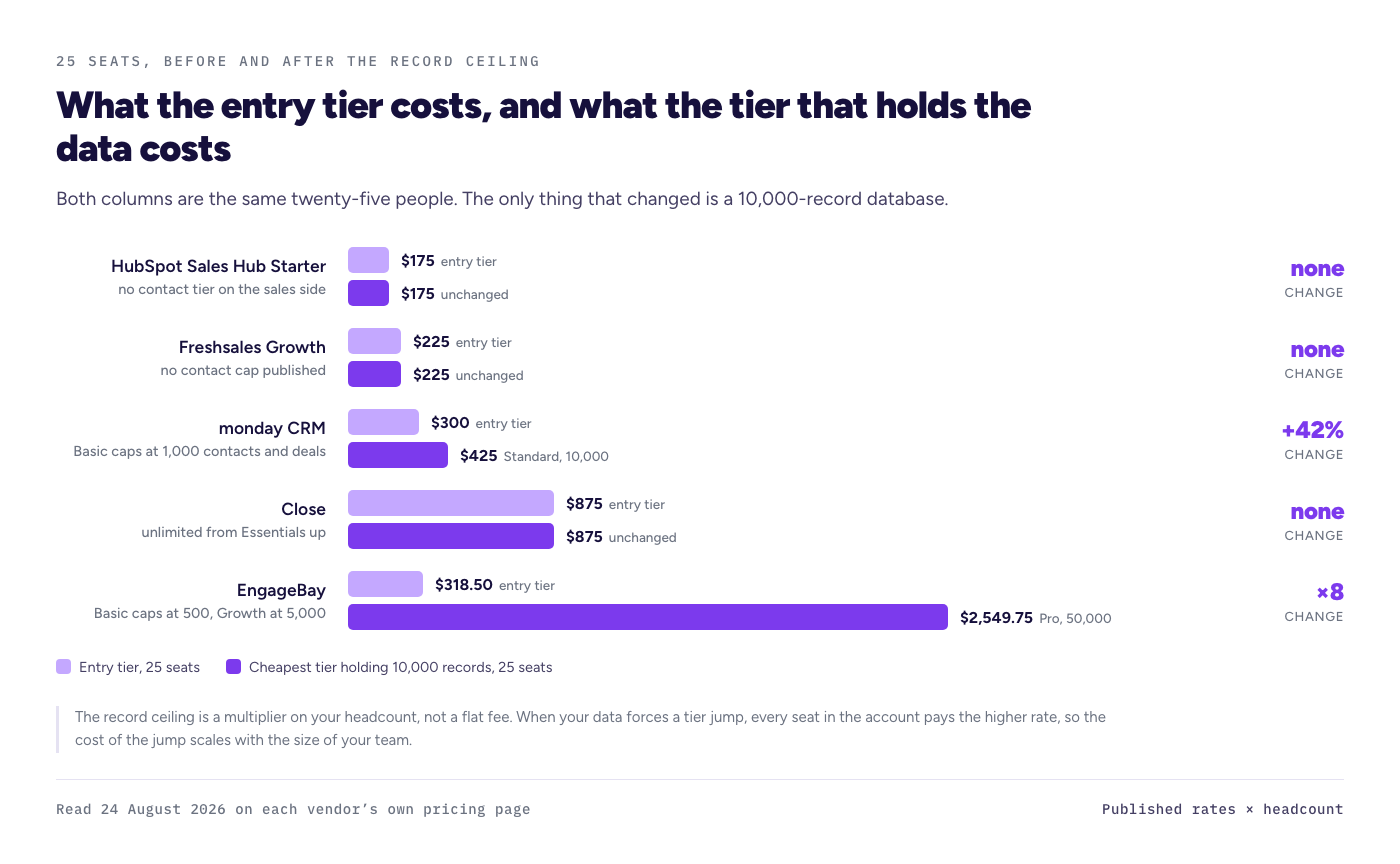
A twenty-five-person sales team with 1,000 total contacts and deals between them is not a real company. So monday's Basic figure of $300 at 25 seats is a number that describes nobody, and EngageBay's $318.50 on a 500-contact ceiling is the same.
The bill again, at a tier that holds 10,000 records
Same three headcounts, same read date. This time each vendor is placed on the cheapest published tier whose stated ceiling holds a 10,000-record database, which is a modest size for a team of ten or more.
| Vendor and plan that holds 10,000 records | 3 seats | 10 seats | 25 seats | Why this tier |
|---|---|---|---|---|
| HubSpot Sales Hub Starter | $21 | $70 | $175 | No contact tier on the sales side, so no change |
| Freshsales Growth | $27 | $90 | $225 | No contact cap published on the page we read |
| monday CRM Standard | $51 | $170 | $425 | Basic caps at 1,000 contacts and deals; Standard's ceiling is 10,000 |
| Close Essentials | $105 | $350 | $875 | Unlimited contacts and leads from Essentials up |
| EngageBay Pro | $305.97 | $1,019.90 | $2,549.75 | Basic caps at 500 and Growth at 5,000, so Pro is the first tier that holds 10,000 |
All figures on the cheapest commitment each vendor publishes: annual for HubSpot, Freshsales, monday and Close; two-year for EngageBay.
Compare the two tables at 25 seats. On entry tiers the range ran from $175 to $1,225 and EngageBay sat near the bottom at $318.50. On tiers that hold the data, EngageBay is at the top at $2,549.75, which is more than fourteen times HubSpot's $175 and nearly three times Close's $875. Nothing about the headcount changed. The database did.
The rule that falls out of it: the record ceiling is a multiplier on your headcount, not a flat fee. When your data forces a tier jump, every seat in the account pays the higher rate, so the cost of the jump scales with the size of your team.
Do seat minimums or seat buckets change these totals?
One published minimum applies in the table above. monday CRM states that plans start from three users, which sets its floor and means any team of one or two pays the three-seat figure.
There is a second question we have deliberately not answered. Our 19 August 2026 read of the live results found repeated claims that monday's seats scale in buckets, so that a four-person team buys five. Those claims came from third-party pages rather than from the vendor, and the numbers around them carried no billing period at all. We have not read monday's own support documentation on seat buckets in full, so no bucket rule is applied in this article's arithmetic. If buckets do apply above three, the monday rows at odd headcounts are understated, and we will correct them with the vendor page cited.
That same 19 August read is worth reporting for what it did not contain. Asked directly which CRMs enforce a minimum number of seats, the ranking pages returned consultancy checklists, a forum thread, vendor marketing and one result about taxi licensing. Not one of them answered the question.
Which vendors we could not read, and why
Each was attempted on 24 August 2026 and none is filled in from another source:
- Pipedrive and Salesforce: both pricing pages refused the request. No figure printed, so neither appears at any headcount above.
- Zoho CRM: the page served Indian rupees in that session. We print no converted dollar figure the vendor does not charge.
- Brevo, treated here only as a sales-platform CRM: the page returned no readable plan content.
- Streak: the two toggle figures could not be attributed to a billing period with confidence, so no per-user price appears. Its published Enterprise tier is stated as being for teams of ten or more, which is exactly the range this page covers, so its absence is a real gap.
- monday Ultimate: quote only, sales call required.
What this page does not do
It does not tell you which CRM to buy. Every total above is entry-level or data-driven placement, not feature parity, and a tier that fits your records may still lack the one thing your team needs. It does not include anything outside the seat price: metered usage such as calling, add-ons, and onboarding fees, which on HubSpot's own page start at a one-time $1,500 for Professional and $3,500 for Enterprise. It does not account for negotiated discounts, which are common at twenty-five seats and are not published anywhere. And nothing here has been used: no account, no invoice, no timed setup, no observed cap.
FAQ
How much does a CRM cost for 10 users?
On the entry tier of each product we could read on 24 August 2026, ten seats came to $70 at HubSpot Sales Hub Starter, $90 at Freshsales Growth, $120 at monday CRM Basic, $127.40 at EngageBay Basic and $350 at Close Essentials, all on each vendor's cheapest published commitment. On a tier that holds 10,000 records, monday rises to $170 and EngageBay to $1,019.90.
How much does a CRM cost for 25 users?
On entry tiers, between $175 and $1,225 a month across the vendors we could read. On tiers that hold a 10,000-record database, between $175 and $2,549.75. The spread widens because record ceilings force different vendors up by different amounts, and every seat pays the higher rate.
Why does my CRM bill jump when I add contacts, not people?
Because most entry tiers carry a record ceiling, and clearing it moves the whole account to a higher per-seat rate. On EngageBay, read 24 August 2026, the step from a 5,000-contact tier to a 50,000-contact tier is $55.24 to $101.99 per user on the two-year rate, and every seat pays it.
Does monday CRM really have a three-seat minimum?
Its pricing page states that plans start from three users, read 24 August 2026. Third-party pages also describe seat buckets above three, but we have not confirmed that in the vendor's own documentation, so no bucket rule is used in the totals on this page.
Are these prices what I will actually pay?
They are published list prices from one named day, multiplied by a headcount. They exclude metered usage, add-ons, onboarding fees and any discount you negotiate, and four vendors could not be read at all that day. Treat them as a floor for comparison, not a quote.