Checked on 2 October 2026. Every clause below was read that day on the vendor's own terms of service or refund policy page. This is research from published legal pages, not a measurement from our own accounts: no refund was requested and no refund was received for this page.
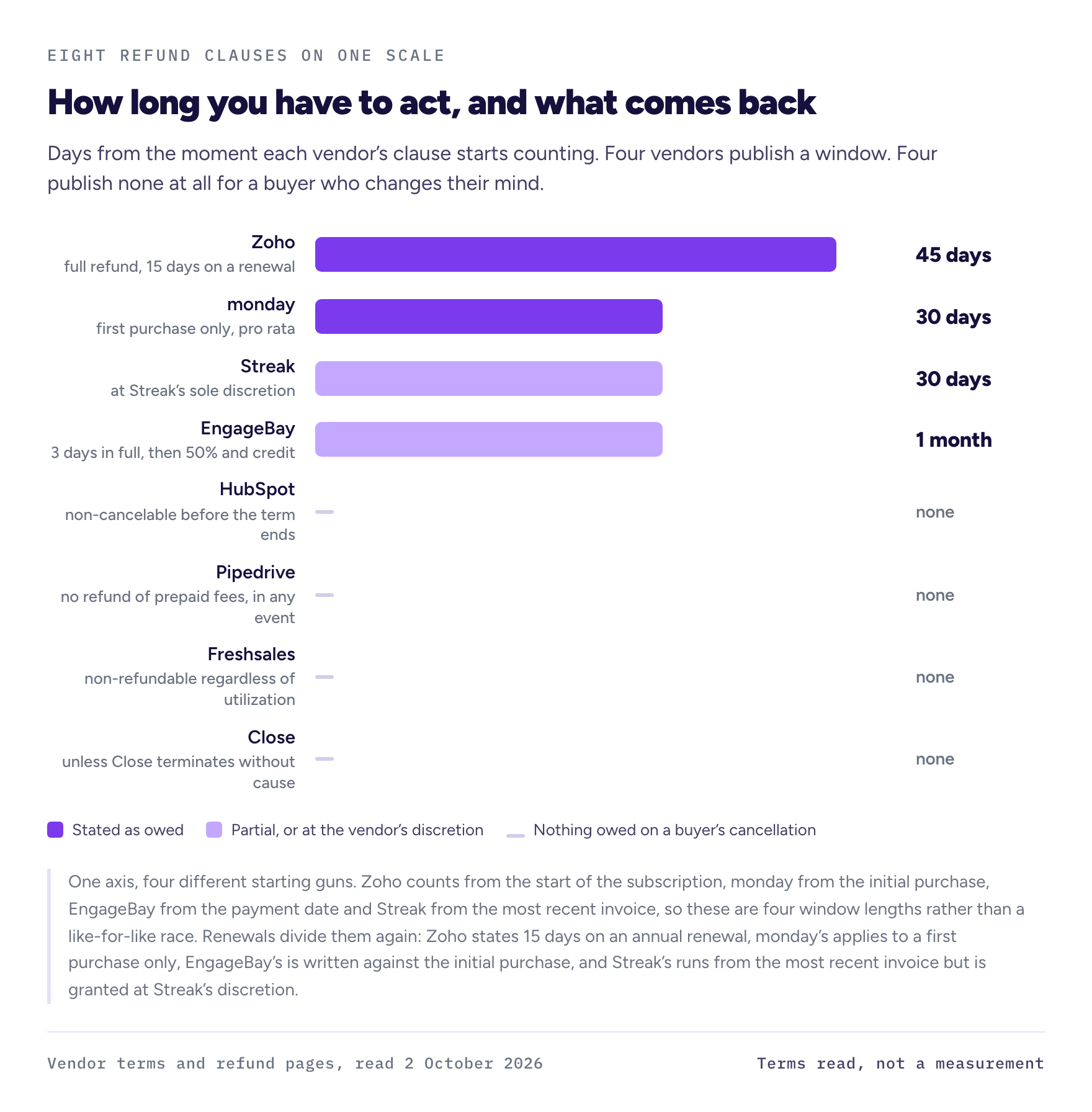
Four of the eight vendors we read publish a refund window on an annual plan. Four publish none. Zoho offers a full refund within the first 45 days of an annual subscription. monday allows written notice within 30 days of a first purchase and returns the unexpired portion. EngageBay refunds the unused months within three days of payment, then 50% plus credit within one month. Streak names 30 days on a yearly invoice but calls refunds discretionary. HubSpot, Pipedrive, Freshsales and Close all say in plain words that fees are non-refundable.
How were these refund terms read?
Each clause comes from the vendor's own public legal page, opened on 2 October 2026, and is quoted rather than paraphrased. Nothing below is taken from a review site, a comparison table, a search snippet or an AI summary, even where those printed a figure. Where a vendor's page says nothing about a situation, this page says nothing about it rather than filling the gap.
The protocol, in short:
- Pages read. Zoho's refund policy page; monday.com's terms of service, sections 8.9 and 9.1; EngageBay's terms of service, refund section; Streak's terms, refund section; Close's terms of service, sections 4 and 6; Pipedrive's terms of service; HubSpot's customer terms of service; the Freshworks terms that cover Freshsales.
- What was not read. Salesforce's master services agreement and Brevo's terms were not opened on the day, so neither appears in the table. Enterprise contracts negotiated by a sales team are also out of scope: the published terms bind self-serve buyers, which is who this site is written for.
- What this page is not. It is a reading of terms, not a record of refunds we asked for and got. The cancellation and refund-request runs are a separate experiment and are not reflected here. The rules behind every number on the site are on our how we measure page.
CRM refund policy by vendor: the annual plan window side by side
The table reduces each vendor's position to the clause that decides whether money comes back. The seat prices those commitments are made against, each with its billing period named, sit in the CRM price index.
| Vendor | Annual refund window, as written | What comes back | Does a renewal qualify? |
|---|---|---|---|
| Zoho | First 45 days of the annual subscription | Full refund, account downgraded to the free plan | Yes, if requested within 15 days of the annual renewal |
| monday | 30 days from the initial purchase, written notice | Pro rata portion of unexpired prepaid fees | No, initial purchase only |
| EngageBay | 3 days from the payment date, then 1 month; nothing after two | Unused months in full, then 50% plus account credit | Not stated as covered |
| Streak | 30 days of the most recent yearly invoice | Not specified; granted at the vendor's sole discretion | The clause is written against the most recent invoice |
| HubSpot | None for buyer-initiated cancellation | Nothing before the end of the current term | No |
| Pipedrive | None for buyer-initiated cancellation | Nothing, unless Pipedrive terminates the agreement | No |
| Freshsales | None for buyer-initiated cancellation | Nothing; obligations are non-cancelable | No |
| Close | None for buyer-initiated cancellation | Nothing, unless Close terminates without cause | No |
Two columns matter more than the headline window. The first is what the clock starts on, because it is not the same event at any two vendors. The second is whether a renewal charge is treated like a first purchase, which is where most of the money that readers want back actually sits.
Which CRM vendors refund anything on an annual plan?
Four do, in their own terms, and the four windows are not comparable.
Zoho is the widest. Its refund policy page states that if you are dissatisfied at any time during your first 45 days, "we are happy to offer a full refund for your purchase and downgrade your account to the free plan." Monthly subscriptions get the same treatment inside the first month. Two extra clauses matter. Beyond the window, Zoho offers a prorated refund if it removes, breaks or discontinues functionality that was available at signup and does not fix it within its promised timelines. And for a renewal nobody meant to pay, the page gives five business days on a monthly renewal and 15 days on an annual one. The exclusion is accounts terminated, suspended or blocked for terms violations, where no refund is issued full or prorated.
monday refunds the first purchase only. Section 9.1 of the monday.com terms lets a customer who is not satisfied with its first purchase terminate by written notice within 30 days and receive "the prorata portion of any unexpired Fees pre-paid by Customer." The next sentence is the one to read twice: "The Refund is applicable only to the Initial Purchase and does not apply to any additional or subsequent purchases." After that period, "the Fees are non-refundable and non-cancellable." Separately, section 8.9 requires at least 30 days' notice before an annual subscription expires, and confirms that a customer who cancels mid-term "will not be refunded or credited for any unused period within the Subscription Term."
EngageBay publishes two tiers and a hard stop. Its terms of service say a full refund for the unused months on an annual plan "may be issued" if the request or cancellation lands within three days of the payment date, and that a 50% refund plus account credit "may be issued" if the plan is cancelled or a refund requested by email within one month of the initial purchase. The credit carries no expiry and can be used on any plan. After two months of an active annual plan, no refund is issued at all. Two things in that are worth reading twice. The second month is unaccounted for: the page names three days, one month and a two-month cut-off, and says nothing about what happens in between. And both tiers are written as "may be issued" rather than will, which puts EngageBay closer to Streak's discretion than to Zoho's promise. Advertising charges, fully managed services and special pricing or discounts are excluded from the policy entirely, which is worth knowing if the headline figure that attracted you was a discount.
Streak names a window but not an obligation. Its terms set 14 days from the most recent invoice on monthly plans and 30 days on yearly ones, then say that "Refunds are granted at the sole discretion of Streak and this policy can be modified at any point." Refunds are never offered for plan downgrades or for removing users. A discretionary 30 days is not the same promise as Zoho's 45, and it should not be budgeted as one.
Which CRM vendors refund nothing, and in what words
The other four are not vague about it, and the vagueness readers expect is the thing that is actually missing.
Pipedrive's terms state flatly that "All Fees are non-refundable," add that there are no refunds or credits for periods where an activated account went unused or only partially used, and close with "Except as otherwise set forth herein, in no event shall Client receive a refund of any Fees prepaid hereunder." Cancellation takes effect at the next renewal date rather than immediately, and annual subscriptions renew for successive years by default. The HubSpot customer terms say "All payment obligations are non-cancelable and all amounts paid are non-refundable, except as specifically provided for in this Agreement," and spell out the consequence: "you may not cancel your subscription prior to the end of your Current Term, and we will not provide any refunds of prepaid fees or unused Subscription Fees through the end of your Current Term."
Freshworks, which covers Freshsales, writes that payment obligations are "non-cancelable, and non-refundable, except as expressly permitted in this Agreement, regardless of utilization by the Customer," and bars reducing the user count or downgrading the plan during the subscription term. Close states that "All fees are non-refundable" in two separate sections. Each of the four does keep one exception, and it points the same way: money comes back when the vendor is at fault. HubSpot and Freshworks both provide a prorated refund of unused prepaid fees where the service materially fails or the agreement is terminated for cause, Close refunds "the prorated, unearned portion" if Close terminates your account without cause, and Pipedrive, where it terminates for its own reasons, states a "pro rata refund of any prepaid, unused Fees for the remainder of the Subscription Term." Pipedrive's is the easiest of the four to miss, because it lives behind the five words that open its no-refund sentence. None of those is a cooling-off period, and none of them is triggered by changing your mind.
The dates to put in a calendar before you pay annually
The practical finding is that the refund question is usually decided weeks before anyone thinks to ask it, by a notice deadline rather than by a refund clause. Freshworks renews automatically unless written notice of non-renewal or downgrade arrives at least 30 days before the term expires, and it states that fees are adjusted upward at renewal with at least 30 days' notice. monday requires no less than 30 days' notice before an annual subscription expires. HubSpot renews unless the auto-renewal setting is turned off in the account's billing section. Pipedrive's cancellation takes effect at the next renewal date, which means cancelling the day after a renewal charge buys another full year of access and returns nothing.
That turns one sentence of the renewal term into the real exit cost of an annual plan, which is the same arithmetic behind the break-even month on monthly versus annual billing. An annual plan that saves 20% and cannot be exited is cheaper only if the tool survives the year. If you are still working out which figure you are even being quoted, start with whether that headline price is monthly or annual, then add the exit line to the rest of the bill using the true cost of ownership worksheet.
What this page does not tell you
It does not tell you what any of these vendors do in practice when asked. A published clause is a floor, not a forecast, and several of these terms reserve discretion in both directions: Streak says so explicitly, and a vendor that owes nothing can still choose to refund. It also does not cover negotiated or enterprise agreements, which override the public terms, nor Salesforce and Brevo, whose documents were not opened on the day. Local consumer law may add rights the terms do not mention, and none of the above is legal advice. Terms pages change without an announcement, which is why the read date sits at the top of this page and why the figures are rechecked on a schedule rather than left to age.
FAQ
Can you get a refund on an annual CRM plan if you cancel early?
At most vendors, no. Of the eight read on 2 October 2026, four state that fees are non-refundable for a buyer-initiated cancellation: HubSpot, Pipedrive, Freshsales and Close. Zoho, monday, EngageBay and Streak each publish a window, ranging from three days to 45, and outside it they also refund nothing.
Which CRM has the longest refund window?
Zoho, on the pages read. Its refund policy offers a full refund within the first 45 days of an annual subscription and downgrades the account to the free plan rather than closing it. monday's 30 days is the next longest, but it applies only to a first purchase.
Are CRM renewal charges refundable?
Usually not. monday's refund applies to the initial purchase only, and EngageBay's policy is written against the initial purchase and the payment date. Zoho is the clear exception: it allows a refund request within 15 days of an annual renewal and five business days of a monthly one. Streak's clause is written against the most recent invoice, which would include a renewal, but Streak calls refunds discretionary.
What happens if the CRM breaks or the vendor shuts a feature off?
That is the one exception the non-refunding vendors keep. HubSpot and Freshworks both provide a prorated refund of unused prepaid fees where the service materially fails or the agreement ends for cause, Close refunds the unearned prorated portion if it terminates an account without cause, and Zoho offers a prorated refund if it removes, breaks or discontinues functionality that existed at signup and does not fix it in time.
Does paying annually ever make sense if nothing is refundable?
It depends on whether the commitment survives the discount. An annual price is a bet that the tool is still in use in month 12, and four of these eight vendors will hold you to the full term whatever happens. The honest comparison is the discount against the probability of switching, which is the calculation set out on the monthly versus annual billing page.