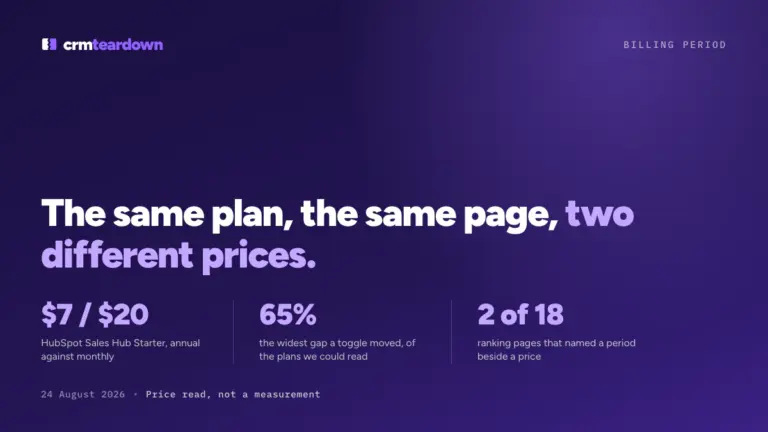
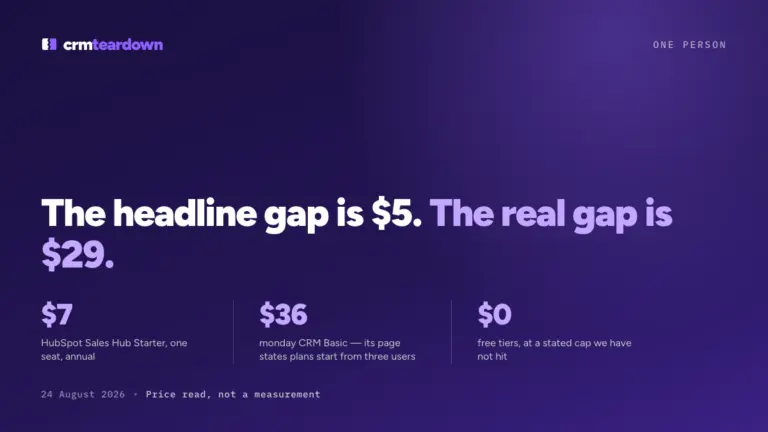
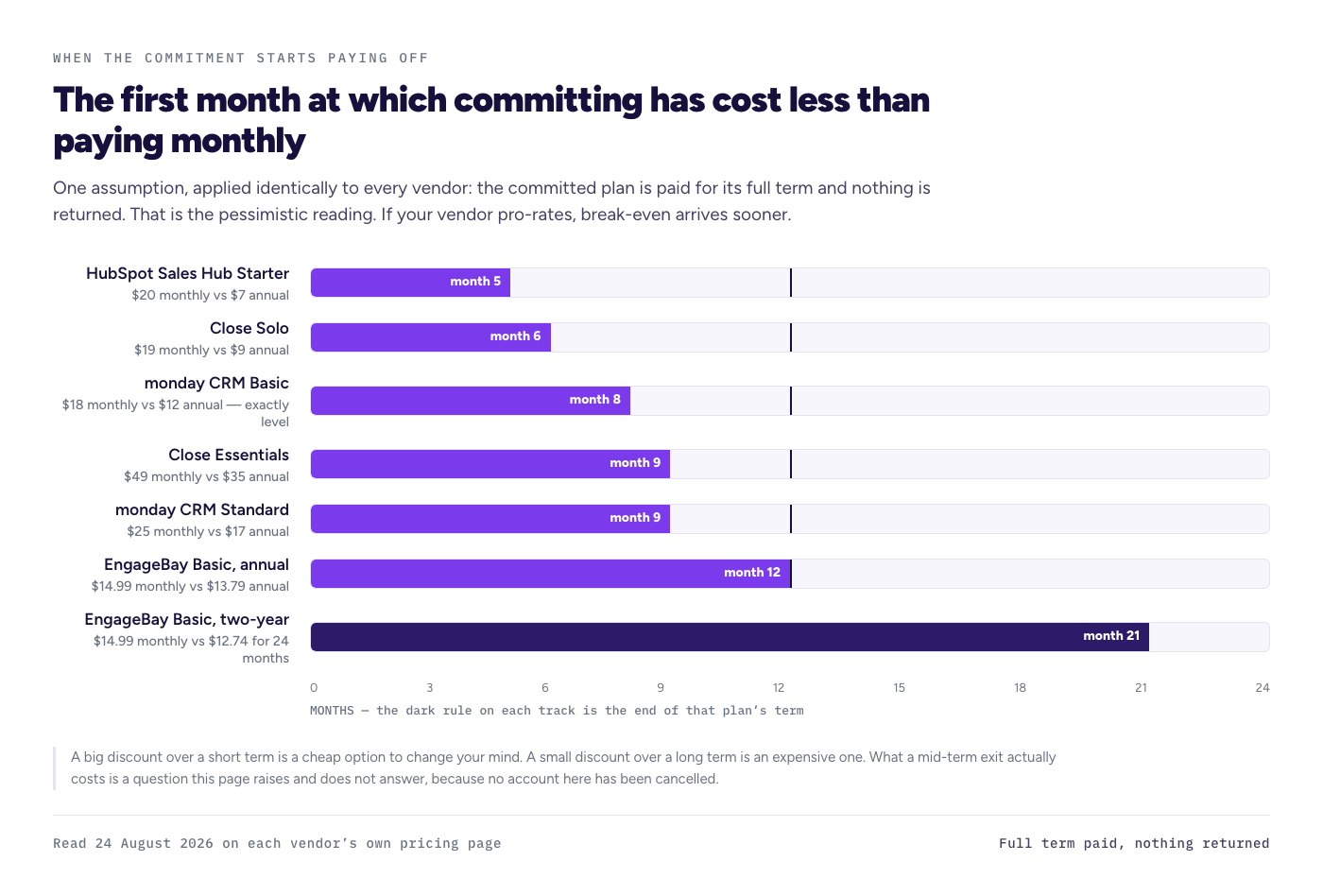
Every CRM pricing page frames the annual rate as a saving, and it is one, but only from a specific month onward. Prices read on 24 August 2026, HubSpot Sales Hub Starter's annual commitment overtakes its monthly rate in month 5. EngageBay's annual rate on Basic does not overtake its monthly rate until month 12, which is the whole term. Its two-year rate does not overtake until month 21 of 24. The percentage on the toggle tells you how much cheaper the rate is. It does not tell you how long you have to stay for that to be true, and that is the number this page computes.
Checked on 24 August 2026. Every price below was read that day on the vendor's own pricing page with the toggle switched both ways. Prices change without notice. Check the vendor's page before you buy.
Is this a test?
No. This is a price read plus arithmetic, not a measurement. No account was opened, no plan was committed to, and no cancellation has been requested at any vendor. What actually happens when you leave a commitment early is a question this page raises and does not answer, and the last section says so in detail.
How is the break-even month calculated?
One stated assumption, applied identically to every vendor: the committed plan is paid for its full term and nothing is returned if you stop using it. That is the ordinary shape of an annual software commitment, and it is the pessimistic reading. If your vendor pro-rates or refunds, the break-even arrives sooner.
On that assumption, the committed plan costs the full term regardless. The monthly plan costs only the months you actually use. So committing is cheaper only once the months you use, at the monthly rate, exceed the total cost of the term. The break-even month is that crossing point.
The arithmetic is simple. What makes it useful is that the crossing point is not where the discount percentage suggests, and it lands in very different places at different vendors.
The break-even month, vendor by vendor
Read 24 August 2026. Per user per month. "Full term in cash" is the committed rate multiplied by the term length. The last column is the first month at which the commitment has cost less than paying monthly would have.
| Vendor and plan | Monthly rate | Committed rate | Term | Full term in cash | Commitment pays off from |
|---|---|---|---|---|---|
| HubSpot Sales Hub Starter | $20 | $7 | 12 months | $84 | month 5 |
| Close Solo | $19 | $9 | 12 months | $108 | month 6 |
| monday CRM Basic | $18 | $12 | 12 months | $144 | month 8, exactly level |
| Close Essentials | $49 | $35 | 12 months | $420 | month 9 |
| monday CRM Standard | $25 | $17 | 12 months | $204 | month 9 |
| monday CRM Pro | $41 | $28 | 12 months | $336 | month 9 |
| Leadfeeder Discover | EUR 113 | EUR 79 | 12 months | EUR 948 | month 9 |
| EngageBay Basic | $14.99 | $13.79 | 12 months | $165.48 | month 12 |
| EngageBay Growth | $64.99 | $59.79 | 12 months | $717.48 | month 12 |
| EngageBay Pro | $119.99 | $110.39 | 12 months | $1,324.68 | month 12 |
| EngageBay Basic | $14.99 | $12.74 | 24 months | $305.76 | month 21 |
| Freshsales Growth | no monthly rate published | $9 | 12 months | $108 | not a choice |
Leadfeeder's figures are in euros because euros are what the page published.
What does the break-even month actually tell you?
It converts a discount into a commitment length, which is the form the decision actually takes.
A wide toggle gap buys you an early exit. HubSpot Sales Hub Starter's annual rate is about 65 percent below its monthly rate, so the year's cost is covered by just over four months of monthly payments. Commit, change your mind in month six, and you are still ahead. Close Solo behaves similarly at month 6.
A narrow toggle gap means the commitment has to run almost its whole length. EngageBay's annual rate is about 8 percent below its monthly rate. Twelve months at $13.79 costs $165.48; eleven months at $14.99 costs $164.89. Stopping one month early erases the entire saving. The annual plan there is not really a discount, it is a term with a rounding error attached.
A two-year rate is a much longer bet than it looks. EngageBay's $12.74 is about 15 percent below its monthly rate, which sounds like the strongest offer on the page, and it is the lowest number on it. But twenty-four months at $12.74 costs $305.76, and it takes twenty-one months of monthly payments at $14.99 to reach that. You must stay for roughly 87 percent of a two-year term before the cheapest published price on the page has saved you anything at all.
And one vendor removes the choice. Freshsales published no monthly rate for Growth on the page we read. There is no break-even to compute, because there is nothing to break even against. The twelve-month commitment is the product.
Does the annual price ever cost more than the monthly price?
Yes, whenever you leave before the break-even month, and the amount is not small.
On the figures above, a single user who commits to EngageBay's two-year Basic rate and stops after six months has paid $305.76 under our stated assumption, against $89.94 for six months at the monthly rate. That is $215.82 for software nobody used, and it happened at the vendor advertising the lowest number on its own page.
The same user committing to HubSpot Sales Hub Starter's annual rate and stopping after six months has paid $84 against $120 monthly, and is $36 ahead. Identical behavior, opposite outcome, decided entirely by how wide the toggle gap is.
The rule that falls out of it: the size of the discount and the length of the term move in opposite directions for the buyer. A big discount over a short term is a cheap option to change your mind. A small discount over a long term is an expensive one.
What happens if you leave a commitment early?
We do not know, and we are not going to guess. This is the honest limit of this page.
Nothing on this site has been canceled, downgraded or refunded, because no paid account has ever been opened here. That means we cannot tell you, from experience:
- whether any of these vendors refunds any part of an unused commitment,
- whether a commitment can be exited at all before its term ends,
- how much notice each vendor requires,
- what the account becomes after you stop paying, and how long your data stays reachable,
- or how far ahead of a renewal each vendor warns you.
Every one of those is a published-terms question first and a measured question second, and this site's answer to all of them today is that the run has not happened. The arithmetic on this page holds under the assumption stated at the top: the term is paid in full and nothing comes back. If a vendor's terms are more generous than that, its break-even month is earlier than the table shows, in your favor.
Treat the table as the worst case and the vendor's contract as the authority.
Which vendors we could not read, and why
Each was attempted on 24 August 2026 and none is filled in from another source:
- Pipedrive and Salesforce: both pricing pages refused the request. No figure printed, so neither has a break-even row.
- Zoho CRM: the page served Indian rupees in that session. We print no converted dollar figure the vendor does not charge.
- Brevo, treated here only as a sales-platform CRM: the page returned no readable plan content.
- Streak: the two toggle figures could not be attributed to a billing period with confidence. Since this entire page is about attributing figures to periods, printing them would have been self-defeating.
What this page does not do
It does not tell you which CRM to buy, and it compares no features. It does not tell you what a mid-term exit costs, for the reasons set out above. It assumes a full-term payment with no refund, which is the pessimistic case and may not be your vendor's case. It ignores everything outside the seat price: metered usage, add-ons and onboarding fees. And it cannot know your real term length, because the honest input to this decision is how long you expect to still be using the product, which nobody knows on signup day.
FAQ
Is annual CRM billing cheaper than monthly?
It is a lower rate at every vendor we could read on 24 August 2026, by between about 8 and 65 percent. Whether it is cheaper for you depends on how long you stay. The crossing point ran from month 5 at HubSpot Sales Hub Starter to month 12 at EngageBay's annual rate, and month 21 of 24 on its two-year rate.
What is the break-even month on a CRM annual plan?
The first month at which the committed term has cost less than paying month to month would have. Computed from prices read 24 August 2026, it is month 5 for HubSpot Sales Hub Starter, month 6 for Close Solo, month 8 for monday CRM Basic, month 9 for Close Essentials and monday's higher tiers, and month 12 for EngageBay's annual rates.
Is a two-year CRM price a good deal?
EngageBay's two-year Basic rate of $12.74 is the lowest published figure on its page, about 15 percent below its monthly rate. Because the term is twice as long, it takes about twenty-one months to pay off. It is a good deal only if you are confident about a two-year horizon, which most small teams are not.
Can I get a refund if I cancel an annual CRM plan?
We have not tested this and we do not state it. No account has been opened, canceled or refunded on this site. Read the vendor's own terms before committing, and treat the break-even figures here as the worst case in which nothing is returned.
Which CRM does not offer monthly billing?
On the page we read on 24 August 2026, Freshsales published its Growth tier at $9 per user billed annually with no month-to-month figure. That makes the twelve-month commitment the only option on that tier, so the low rate and the obligation arrive together.