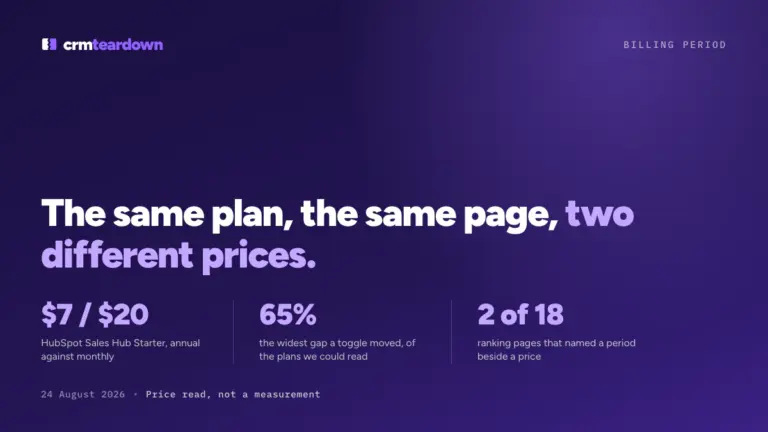
Almost every CRM comparison you can find prints one number per vendor and never says whether that number is the monthly price, the annual price, or a two-year commitment. That single omission makes the whole table meaningless, because the gap between those positions is large enough to reverse the ranking. Read on 24 August 2026, Close Solo is $9 per user a month on annual commitment and $19 paying monthly, and EngageBay's headline Basic figure of $12.74 is a two-year rate against $14.99 month to month. This page is the start of a dated record that names the period every time.
Checked on 24 August 2026. Every figure below was read that day on the vendor's own pricing page. Software pricing changes without notice, promotional rates expire, and this is a record of one day rather than a promise about yours. Check the vendor's page before you buy.
Is this a test?
No. This is a price read, not a measurement. No account was opened, no seat was bought and no invoice exists behind this page. Nothing here comes from a comparison article, a search snippet or a generated summary.
One further limitation, stated because it matters: this snapshot was collected by an automated read of each vendor's public pricing page. Under our own protocol a row is only marked as confirmed once a person has seen it on screen in a US-located browser with the toggle switched both ways, and that confirmation pass has not happened yet. Treat snapshot 1 as a dated read of published pages, which is what it is.
What is a CRM price index and why does the date matter more than the number?
It is a record of what each vendor published on one named day, kept so the next reading can be compared against it. The number on its own tells you little, because it changes and because every competitor quotes it differently. The record tells you who changed what and when, and that only exists if somebody started keeping it. Snapshot 1 is worth little. Snapshot 4 is worth a great deal.
That is the honest case for this page. It gains value with age, and it cannot be backdated. A price history assembled later out of other people's blog posts is not a price history.
The index, snapshot 1
Read 24 August 2026. Prices are per user per month unless the row says otherwise, and the commitment that produces each figure is named on the same line. "Quote" means the vendor publishes no price for that tier.
| Vendor and plan | Paying monthly | On annual commitment | On two-year commitment | Record or contact cap published on the page |
|---|---|---|---|---|
| HubSpot Sales Hub Starter | $20 per seat | $7 per seat | not offered | No contact tier on the sales side |
| Freshsales Growth | not published on the page we read | $9 per user | not offered | No contact cap published on the page |
| Close Solo | $19 per user | $9 per user | not offered | Up to 10,000, single user |
| Close Essentials | $49 per user | $35 per user | not offered | Unlimited contacts and leads |
| monday CRM Basic | $18 per seat | $12 per seat | not offered | 1,000 active contacts and deals |
| monday CRM Standard | $25 per seat | $17 per seat | not offered | 10,000 active contacts and deals |
| monday CRM Pro | $41 per seat | $28 per seat | not offered | 100,000 active contacts and deals |
| monday CRM Ultimate | quote | quote | quote | not published |
| EngageBay Basic | $14.99 per user | $13.79 per user | $12.74 per user | 500 contacts |
| EngageBay Growth | $64.99 per user | $59.79 per user | $55.24 per user | 5,000 contacts |
| EngageBay Pro | $119.99 per user | $110.39 per user | $101.99 per user | 50,000 contacts |
| Leadfeeder Discover | EUR 113 per month | EUR 79 per month | not offered | Priced by identified companies, users unlimited |
| Leadfeeder Activate | EUR 527 per month | EUR 369 per month | not offered | Priced by identified companies, users unlimited |
Leadfeeder's figures are printed in euros because euros are what the page published. We do not convert them into a dollar figure the vendor does not charge.
Two free tiers appear on the pages we read and belong in the record: EngageBay publishes a free plan capped at 250 contacts, and Leadfeeder Lite publishes a free tier showing the last 100 companies per month. Those are stated caps, not caps we have hit.
Where each figure was read
Part of keeping a price record is saying where each number came from, so the reading can be repeated. On 24 August 2026 the pages read were hubspot.com/pricing/sales, freshworks.com/crm/pricing, close.com/pricing, monday.com/crm/pricing and engagebay.com/pricing, plus Leadfeeder's published pricing page. Each was read logged out, with the billing toggle moved through every position the page offered.
Which seat minimums and rules change the bill before you compare anything?
Two published rules move the real total more than most tier differences do, and neither appears inside a headline price.
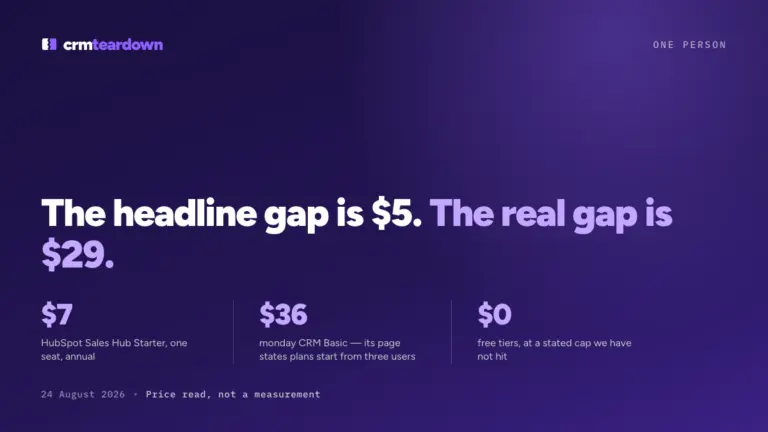
monday CRM states that plans start from three users. A two-person team therefore buys three seats. On Basic at the annual rate that is a floor of $36 a month rather than $24, and paying monthly it is $54 rather than $36. Anyone comparing monday's $12 against another vendor's $12 is comparing a three-seat purchase against a one-seat purchase.
Close's Solo plan is single user by definition, so its $9 annual figure is not available to a team of any size. The first plan a second person can join is Essentials, and the step from $9 to $35 per user on annual commitment is a four-fold jump caused by adding one colleague rather than by adding a feature.
Streak publishes its Enterprise tier as being for teams of ten or more, which does not raise a small team's bill but does put a tier out of reach.
What does the headline figure hide?
Three things, consistently, across the pages we read.
The billing period. The default toggle position on a pricing page is almost always the one that shows the lower number. Close Solo moves from $19 to $9, roughly a 53 percent gap, on the same page. HubSpot Sales Hub Starter moves from $20 to $7. EngageBay has three positions rather than two, and its lowest is a two-year commitment. Freshsales published annual figures only on the page we read, which means its $9 is not a monthly option that exists.
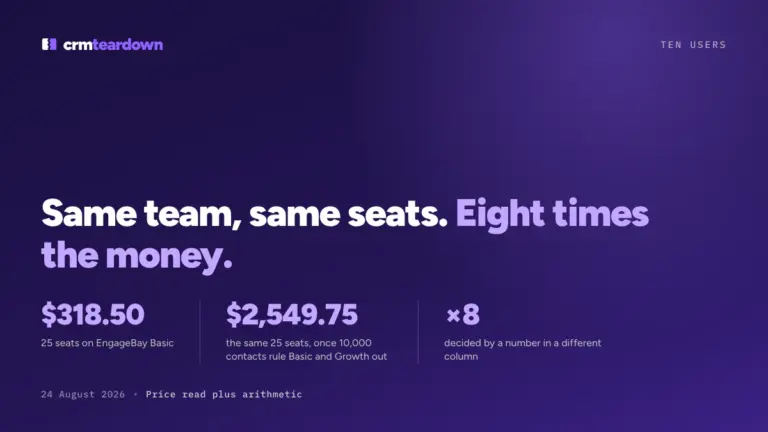
The record allowance, and that it is bought per seat. monday counts contacts and deals against one allowance, so a team with 8,000 contacts and 3,000 open deals is over a 10,000 ceiling and nothing on the pricing table says the deals were the problem. EngageBay's tiers are separated by contact ceilings, so a list that clears one ceiling moves every seat in the account to the higher rate, not just one.
Costs that are not on the pricing table at all. HubSpot's page lists a one-time onboarding fee of $1,500 for Professional and $3,500 for Enterprise. Metered usage such as calling sits outside the seat price entirely. Neither shows up in a comparison of per-seat rates.
There is also a gap that is itself a finding: HubSpot's pricing page publishes the marketing contact tiers that are included, at 1,000, 2,000 and 10,000, but not what the next block of contacts costs. The price of contact growth is not on the page where you would go to price contact growth.
Which vendors are missing from snapshot 1, and why?
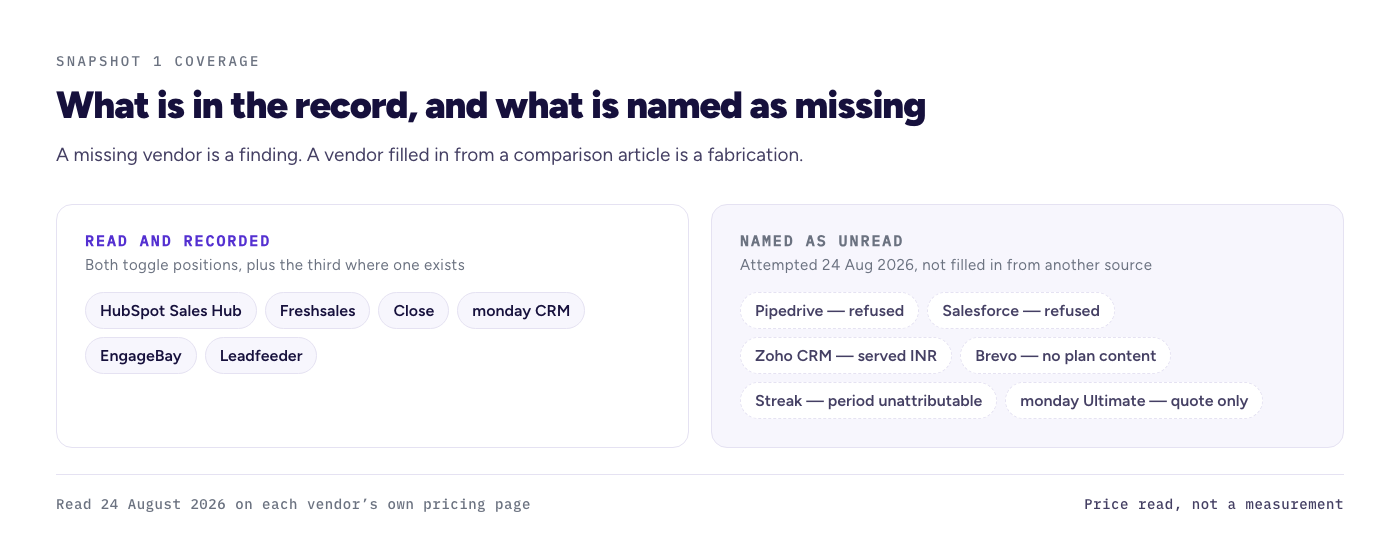
Naming the gaps is part of the record. Each of these was attempted on 24 August 2026 and none is filled in from another source.
- Pipedrive and Salesforce: both pricing pages refused the request outright. No figure printed.
- Zoho CRM: the pricing page served Indian rupees in that session. We print no converted dollar figure, so Zoho stays out until the page is read in a USD session by hand.
- Brevo, which this site treats only as a sales-platform CRM: the pricing page returned no readable plan content.
- Streak: the page shows a monthly and annual toggle whose two figures could not be attributed to a billing period with confidence, so no Streak per-user price appears above. Its stated Enterprise minimum is quoted because it is unambiguous.
- monday Ultimate: quote only, sales call required. A tier with no published price cannot be compared, and that is the finding rather than a hole in it.
This is why the index is smaller than the roster. It grows as those pages are read by hand, and every addition arrives with its own read date rather than being folded silently into an earlier snapshot.
How this record is kept
Six rules, so that snapshot 2 means something:
- Every row carries the date it was read and the page it was read from.
- Both toggle positions are recorded, and the third where a vendor offers a two-year rate.
- A past reading is never edited. A correction is a new dated row that names the row it corrects.
- Currencies are recorded as published. A conversion, where one is useful, carries its rate and date and never replaces the original figure.
- The reading repeats about every 30 days. A missed month is recorded as missed, never backfilled.
- Each new snapshot is compared against the previous one, and the differences are what the tracked-changes page is built from.
What this page does not do
It does not tell you which CRM to buy, and this site publishes no "best CRM" ranking. It does not compare features, so two plans on the same row of the table above may not do remotely the same job. It does not tell you what you will pay, because seat count, record count, negotiated discounts and any contract you sign all sit outside a published price. It has nothing to say about whether any of these products is good, because nothing here has been used. And it is a snapshot: the older the date at the top, the less the numbers below are worth.
FAQ
Is the price on a CRM pricing page monthly or annual?
Usually the discounted commitment, shown by default. Read on 24 August 2026, EngageBay's lowest published figures are two-year rates, Freshsales published annual figures only, Close Solo showed $9 annual against $19 monthly, and HubSpot Sales Hub Starter showed $7 annual against $20 monthly. Find the toggle before comparing two vendors.
Why are Pipedrive, Salesforce, Zoho and Brevo not in the table?
Because their pricing pages could not be read on 24 August 2026 under our rules: two refused the request, one served a non-USD currency, and one returned no readable plan content. We would rather publish a smaller table with a named exclusion list than a complete-looking one containing figures we did not read.
What is a seat minimum and which vendors have one?
A rule that stops you buying fewer than a set number of seats. On the pages read on 24 August 2026, monday CRM stated that plans start from three users, so a two-person team pays for three. Close Solo is single user, which is the opposite constraint: a second person forces a move to a plan roughly four times the per-user rate.
How often is this index updated?
About every 30 days. Each reading is added as a new dated snapshot rather than overwriting the last one, so the record shows what changed and when. If the date at the top of this page is more than a month old, treat every number on it as historical.
Can I use these numbers to budget?
Only as a starting point, and only with the date attached. They are published list prices from one day, not quotes, and they exclude onboarding fees, metered usage such as calling, and anything negotiated. The vendor's current page is the only thing you should sign against.