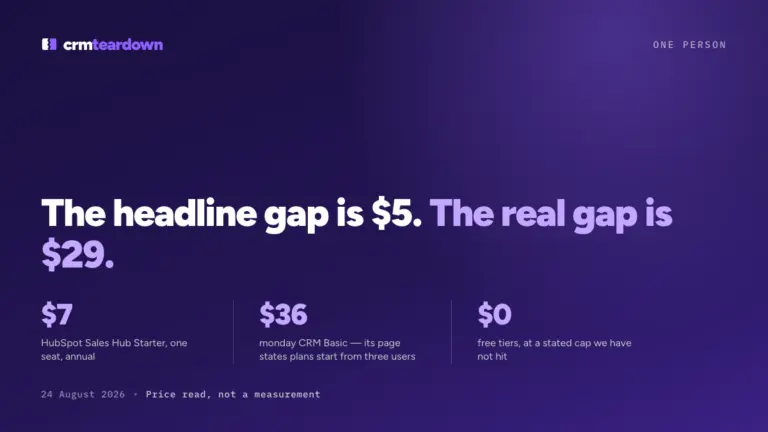
The number on a CRM pricing page is almost never the number you pay month to month, and the page rarely says so on the same line. Read on 24 August 2026, Close's Solo plan shows $9 per user with an annual commitment and $19 paying monthly, a gap of about 53 percent. HubSpot Sales Hub Starter shows $7 per seat annual against $20 monthly, about 65 percent. EngageBay's lowest published figure is not even an annual rate, it is a two-year one. This page prints both positions, and the third where it exists, with the commitment named beside each figure.
Checked on 24 August 2026. Every figure below was read that day on the vendor's own pricing page with the toggle switched both ways. Prices change without notice and promotional rates expire. Check the vendor's page before you buy.
Is this a test?
No. This is a price read, not a measurement. No account was opened and no invoice exists behind this page.
One further limitation we would rather state than hide: our own standard for this page is a screenshot of each toggle position taken in our own session, and those screenshots do not exist yet. The two positions were read from each vendor's published page on 24 August 2026 by an automated read, not confirmed on screen by a person. That is weaker evidence than a screenshot and the difference is worth knowing.
Why does the billing toggle matter more than the price?
Because the toggle changes the number by more than most vendor-to-vendor differences do. A pricing page that defaults to the annual position and a pricing page that defaults to the monthly position will look 30 to 65 percent apart on identical products. Any comparison that does not name the period is comparing toggle defaults rather than prices.
It also decides how much freedom you keep. The lower figure is the price of committing for a year or two. If you leave in month three, you did not get the lower figure. You paid it, and you paid it for the months you did not use.
Both toggle positions, plan by plan
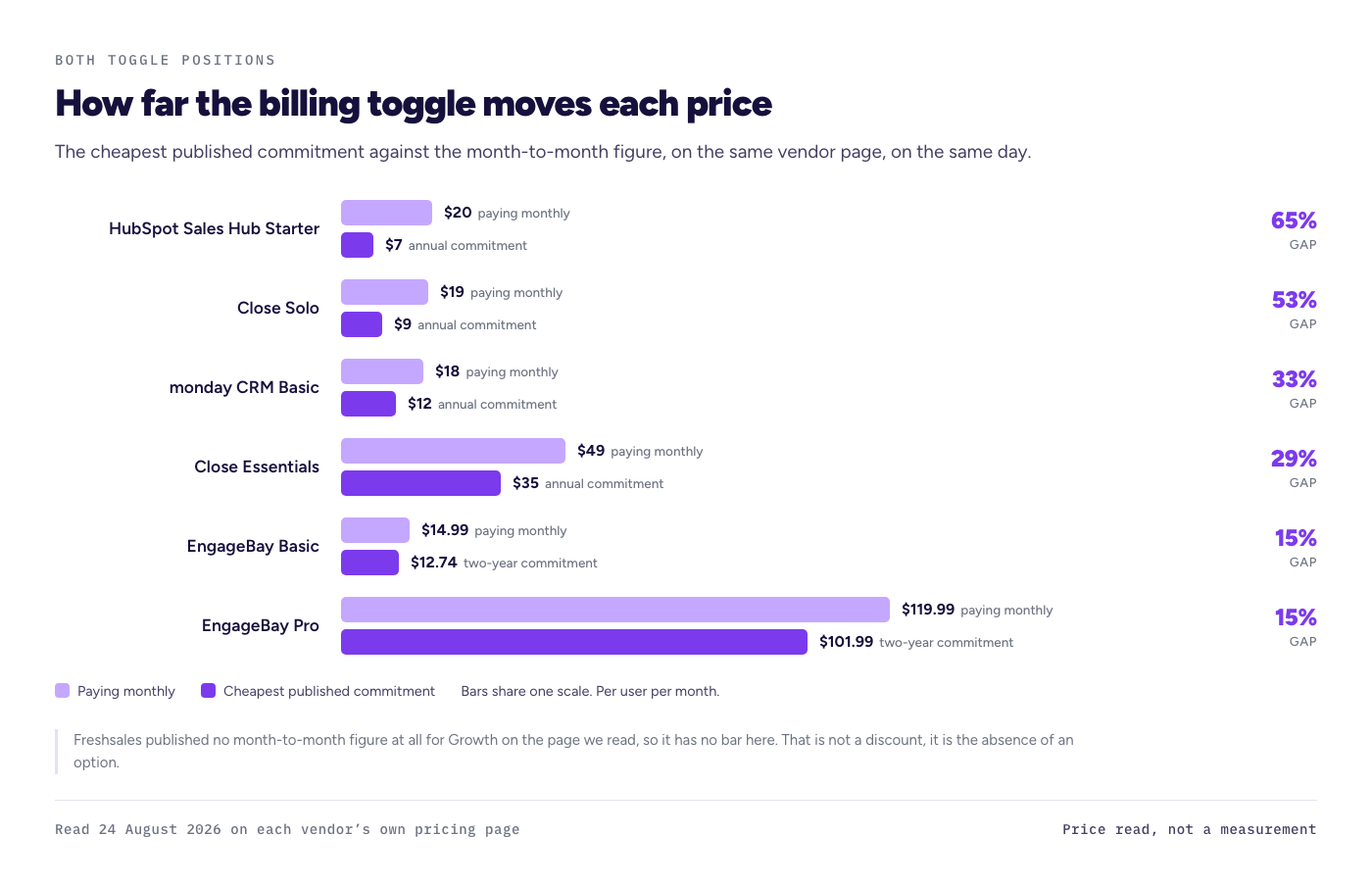
Read 24 August 2026. Per user per month in every case. The last column is how far the cheapest published commitment sits below the month-to-month figure, computed from the two numbers on the same row.
| Vendor and plan | Paying monthly | On annual commitment | On two-year commitment | Gap between the cheapest commitment and monthly |
|---|---|---|---|---|
| HubSpot Sales Hub Starter | $20 | $7 | not offered | about 65 percent |
| Close Solo | $19 | $9 | not offered | about 53 percent |
| monday CRM Basic | $18 | $12 | not offered | about 33 percent |
| monday CRM Standard | $25 | $17 | not offered | 32 percent |
| monday CRM Pro | $41 | $28 | not offered | about 32 percent |
| Close Essentials | $49 | $35 | not offered | about 29 percent |
| Leadfeeder Discover | EUR 113 | EUR 79 | not offered | about 30 percent |
| Leadfeeder Activate | EUR 527 | EUR 369 | not offered | 30 percent |
| EngageBay Basic | $14.99 | $13.79 | $12.74 | about 15 percent |
| EngageBay Growth | $64.99 | $59.79 | $55.24 | 15 percent |
| EngageBay Pro | $119.99 | $110.39 | $101.99 | 15 percent |
| Freshsales Growth | no monthly figure published on the page we read | $9 | not offered | not computable |
Leadfeeder's figures are in euros because euros are what the page published. We do not print a converted dollar figure the vendor does not charge.
Which vendors quote a discounted price as the headline figure?
Three distinct behaviors showed up on the pages we read, and they are worth telling apart.
The two-year headline. EngageBay. Its lowest published figure for each tier, $12.74 on Basic, $55.24 on Growth and $101.99 on Pro, is a two-year commitment rate. There is a separate annual rate above it, at $13.79, $59.79 and $110.39, and a monthly rate above that. Three positions rather than the usual two means the cheapest figure on the page requires a commitment twice as long as the one most readers assume they are looking at.
The annual-only page. Freshsales. On the page we read, its Growth tier published $9 per user billed annually and no month-to-month figure at all. That is not a discount, it is the absence of an option: the twelve-month commitment is the product. A comparison that lists Freshsales at $9 next to a competitor's monthly figure is comparing a year of obligation against a month of it.
The wide default. Close and HubSpot. Both publish a monthly figure and an annual figure on the same page, and both gaps are large: about 53 percent on Close Solo and about 65 percent on HubSpot Sales Hub Starter. Nothing is hidden here. The number is simply much bigger in one toggle position than the other, and only one of the two positions tends to travel into comparison tables.
The narrow one. monday. Its three published CRM tiers each sit about a third below their monthly rate, which is a normal annual discount rather than a headline trick.
What does nobody else say about this?
That they read the toggle at all.
On 19 August 2026 we read the live results for eighteen pricing queries in this category and recorded what each ranking page did with the billing period. Across that whole sweep, exactly two pages stated a billing period beside a price. Everything else printed a bare figure, usually "from $X", with no indication of which position it came from.
The consequence is visible on one product. Two separate dated 2026 articles about the same CRM published different prices for the same plan, and a third figure again for a second plan. Neither showed a dated screenshot, and neither said which toggle position it had used. At least one of them was wrong, and a reader had no way to tell which. That is the failure mode this page exists to avoid, and it is also why we date every reading rather than describing a price as current.
The same sweep turned up a second habit worth naming: several pages state a rule of thumb, such as monthly billing adding some fixed percentage to every plan, with no source and no arithmetic behind it. On the twelve plans in the table above the real spread runs from about 15 percent to about 65 percent, so no single multiplier describes this market.
Which vendors we could not read, and why
Every one of these was attempted on 24 August 2026 and none is filled in from another source:
- Pipedrive and Salesforce: both pricing pages refused the request. No figure printed.
- Zoho CRM: the page served Indian rupees in that session, and we print no converted dollar figure the vendor does not charge.
- Brevo, treated here only as a sales-platform CRM: the page returned no readable plan content.
- Streak: the page shows a monthly and annual toggle, but the two figures could not be attributed to a billing period with confidence from the page as it reached us. Given that this article is entirely about attributing figures to billing periods, printing them would have been self-defeating.
- monday Ultimate: quote only. No published price, so no toggle.
What this page does not do
It does not tell you which CRM to buy, and it does not compare features, so two plans in the table above may do entirely different jobs for the same money. It does not cover what happens if you leave partway through a commitment, which depends on terms we have not tested and cancellations we have not run. And it does not include anything outside the seat price: onboarding fees, metered usage such as calling, and add-ons all sit off this table.
FAQ
Is CRM pricing usually monthly or annual?
Most vendors publish both, and default the page to the annual figure because it is lower. Read on 24 August 2026, the gap ran from about 15 percent on EngageBay to about 65 percent on HubSpot Sales Hub Starter. One vendor in our read, Freshsales, published no monthly figure at all for the tier we looked at.
Which CRM has the biggest gap between monthly and annual pricing?
Of the plans we could read on 24 August 2026, HubSpot Sales Hub Starter had the widest, at $7 per seat annual against $20 monthly, about 65 percent. Close Solo was next at $9 against $19, about 53 percent. Both are published on the vendor's own page; neither is hidden.
What is a two-year CRM price?
A rate that requires a 24-month commitment. EngageBay publishes one for each paid tier, and it is the lowest number on the page, below both its annual and its monthly rate. If you see EngageBay quoted at $12.74 with no period attached, that is the two-year figure.
Does annual billing always save money?
It always lowers the per-month rate on the pages we read. Whether it saves you money depends on whether you stay. Paying twelve months up front to leave in month four is more expensive than the monthly rate you avoided, and the exit terms are a separate question that this page does not answer.
Why do two comparison articles list different prices for the same plan?
Usually because they read different toggle positions, or read the page on different days, and neither said which. In our 19 August 2026 read of eighteen pricing queries, only two ranking pages stated a billing period next to a price at all. A price without a date and a period is not checkable.