Per-user pricing bills your headcount, per-contact pricing bills your database, and the same CRM can be the cheapest or the most expensive option on your shortlist depending on which of those two numbers is the big one. Priced from the vendors' own pages on 24 August 2026, a two-person team with 12,000 contacts pays $203.98 a month on EngageBay Pro at its two-year rate, while a twelve-person team with 200 contacts pays $152.88 a month on EngageBay Basic. Ten fewer people, fifty-one dollars more.
Checked on 24 August 2026. Every figure below was read that day on the vendor's own pricing page, and the page URL and the billing period sit next to each number. Software pricing changes without notice and promotional rates expire, so this is a dated record of what each vendor published on one day, not a promise about the day you read it. Check the vendor's page before you buy.
Is this page a test?
No. This is a price read, not a measurement. Nobody opened an account, ran a pipeline or paid an invoice for this page, and no number here comes from a third-party comparison, a SERP snippet or an AI summary. Where a vendor's page could not be read today, that vendor is left out and named in the exclusions below rather than filled in from memory.
What is the difference between per user and per contact CRM pricing?
Per-user (per-seat) pricing multiplies one price by the number of people who log in. Per-contact pricing sets the price by how many records you keep or market to, usually as pre-bought tiers rather than a per-record meter. Flat pricing charges one figure for the whole account. Most CRMs sold to small teams are hybrids: a per-seat price with a contact ceiling attached to each tier.
That hybrid is where the money hides, and it is why the comparison tables that list nine headline prices side by side cannot answer the question you actually have.
The two team shapes we priced
Two profiles, both real shapes, deliberately opposite:
- Profile A, the list-heavy shape. Two users, 12,000 contacts. A founder and one salesperson sitting on years of accumulated records. Common in ecommerce, newsletters and consultancies.
- Profile B, the seat-heavy shape. Twelve users, 200 contacts. An agency or a field team where everyone needs access and the account list is short and high value.
The same requirement in both cases: every person needs a login, every contact needs to be stored in the CRM, and the plan has to be one the vendor sells without a sales call.
Per user vs per contact: what does each shape actually pay?
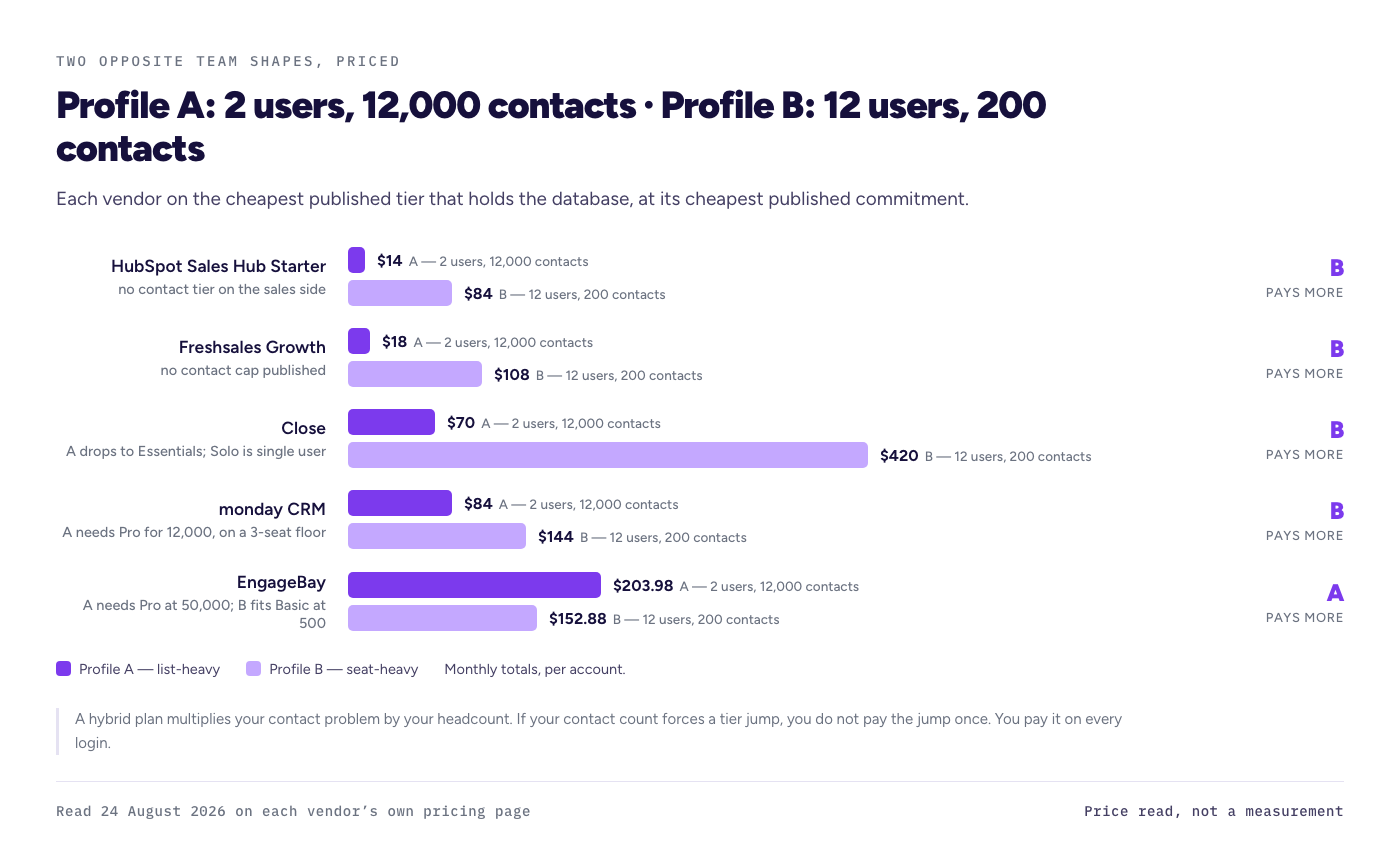
Totals are per month, calculated from the plan price and the seat count. Where a vendor publishes two figures, both are shown with the commitment named.
| Vendor and plan | Why this tier | Profile A, 2 users, 12,000 contacts | Profile B, 12 users, 200 contacts | Page read 2026-08-24 |
|---|---|---|---|---|
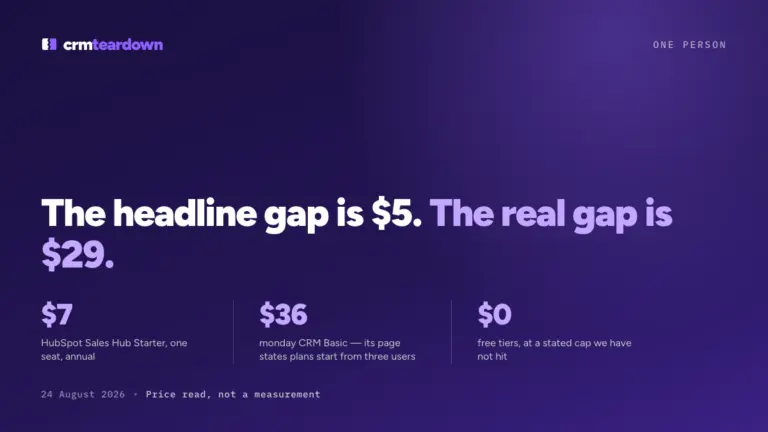
| HubSpot Sales Hub Starter | No contact tier on the sales side | $14 annual ($40 billed monthly) | $84 annual ($240 billed monthly) | hubspot.com/pricing/sales |
| Freshsales Growth | No contact cap published on the page | $18 billed annually | $108 billed annually | freshworks.com/crm/pricing |
| Close | A drops to Essentials, Solo caps at 10,000 contacts and is a single user | $70 annual ($98 billed monthly) | $420 annual ($588 billed monthly) | close.com/pricing |
| monday CRM | A needs Pro for 12,000 records; B fits Basic; 3-seat floor applies to A | $84 annual ($123 billed monthly) | $144 annual ($216 billed monthly) | monday.com/crm/pricing |
| EngageBay | A needs Pro (50,000 contacts); B fits Basic (500 contacts) | $203.98 two-year rate ($220.78 annual, $239.98 monthly) | $152.88 two-year rate ($165.48 annual, $179.88 monthly) | engagebay.com/pricing |
The plan prices those totals are built from, quoted as published on 24 August 2026: HubSpot Sales Hub Starter "$7/mo/seat" on annual commitment and "$20/mo/seat" paying monthly; Freshsales Growth "$9/user/month, billed annually"; Close Solo "$9 per user / month" annual against $19 monthly, Essentials "$35 per user / month" annual against $49 monthly; monday CRM Basic $12 per seat annual against $18 monthly, Standard $17 against $25, Pro $28 against $41; EngageBay Basic $12.74 on a two-year commitment, $13.79 annual, $14.99 monthly, Growth $55.24 / $59.79 / $64.99, Pro $101.99 / $110.39 / $119.99.
Why does the small team pay more on the same product?
Because the contact allowance is bought once per seat, not once per account. That is the sentence the comparison pages leave out, and it is the whole mechanism.
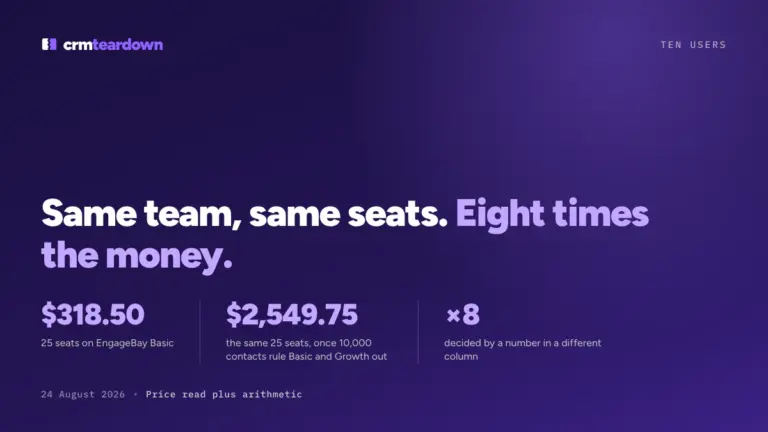
EngageBay's contact ceiling is what separates its tiers: 500 contacts on Basic, 5,000 on Growth, 50,000 on Pro. Profile A's 12,000 contacts clear Growth's ceiling, so the only plan that holds them is Pro at $101.99 per user per month on the two-year rate, which is eight times the Basic rate. Both of A's two users pay it. Profile B's 200 contacts fit inside Basic, so all twelve of B's users pay $12.74. Two seats at the punished rate beat twelve seats at the cheap one, and the two-person team ends up $51.10 a month more expensive than the team six times its size.
monday CRM does the milder version of the same thing. Its tiers count "active contacts & deals" at 1,000 on Basic, 10,000 on Standard and 100,000 on Pro, so Profile A is pushed from $12 to $28 per seat by the records alone, and then pays that on a minimum of three seats because the page states "Plans start from 3 users." A two-person team buys a third seat it will not use.
The rule that falls out of it: a hybrid plan multiplies your contact problem by your headcount. If your contact count forces a tier jump, you do not pay the jump once. You pay it on every login.
Per-seat-only pricing breaks the opposite way, and more obviously. Close charges the same $35 Essentials seat regardless of list size, which is why Profile A gets out for $70 and Profile B pays $420 for the identical product, a six-fold swing driven entirely by headcount.
What counts as a billable contact?
Not the same thing at any two vendors, which is why "12,000 contacts" is not a portable number.
- HubSpot splits the database in two. Its marketing pricing page defines marketing contacts as "contacts that count toward your paid contact tier and can be targeted with marketing emails and ads," and states that non-marketing contacts can be stored free up to 15 million. So 12,000 stored records cost nothing extra on Sales Hub, while the same 12,000 as marketing contacts would exceed the 1,000 included with Marketing Hub Starter or the 2,000 with Professional. Read the label on your own records before you price the plan.
- monday CRM counts contacts and deals against one allowance. A team with 8,000 contacts and 3,000 open deals is at 11,000 against a 10,000 ceiling, and nothing on the pricing table says the deals were the problem.
- Close applies its cap only where it exists: "Up to 10,000" on Solo, "Unlimited contacts & leads" from Essentials up.
- EngageBay counts contacts per plan, flat: 250 free, 500, 5,000, 50,000.
- Leadfeeder prices by records you never created at all. Its Lite plan shows "Last 100 companies/month" free, Discover starts at "€79 Per month, billed annually" against €113 monthly, and Activate at "€369 Per month, billed annually" against €527 monthly, tiered by identified companies, with users unlimited on paid plans. That is the pure opposite of per-seat: Profile B's twelve people cost nothing, and the bill moves only when more companies visit the site. Figures are in euros as published, and we do not print a converted dollar figure the vendor does not charge.
Do CRM seat minimums exist?
Yes, and they land on the small team. monday CRM states plans start from three users, so Profile A pays a 50 percent seat surcharge before any feature question. Streak's FAQ puts its Enterprise tier at "teams of 10 or more," which does not raise a small team's bill but does put a tier out of reach. Neither number is visible in a headline price comparison.
What this page does not do
It does not tell you which CRM to buy. This site publishes no "best CRM" ranking, and a plan that wins on price can lose on the one feature your pipeline depends on. Nothing here has been run: no account, no invoice, no timed setup. Feature parity is not assessed, and every entry-level tier in the table above is entry-level for a reason.
It also does not cover everything a bill contains. Onboarding fees are excluded from the totals and they are not small where they exist: HubSpot's page lists a one-time $1,500 Professional onboarding fee and $3,500 for Enterprise. Metered usage sits outside the seat price too, calling on Close being the obvious case, and that is a separate page with a real invoice behind it.
Which vendors we could not read today, and why
Naming the gaps is part of the record. Every one of these was attempted on 24 August 2026 and none is filled in from another source:
- Pipedrive and Salesforce: both pricing pages returned HTTP 403 to us. No figure printed.
- Zoho CRM: the pricing page served Indian rupees in this session. We print no converted dollar figure, so Zoho is out until the page is read in a USD session by hand.
- Brevo, which this site treats only as a sales-platform CRM: the pricing page returned no readable plan content.
- Streak: the page shows a monthly and annual toggle whose two figures we could not attribute to a billing period with confidence from the page as it reached us, so no Streak per-user price appears above. Its stated Enterprise minimum of "teams of 10 or more" is quoted because it is unambiguous.
- HubSpot's incremental marketing contact price: the pricing page publishes the included tiers (1,000, 2,000, 10,000) but not what the next block of contacts costs. The cost of contact growth is not on the page where you would price contact growth.
- monday Ultimate: custom pricing, sales call required. A tier with no published price cannot be compared, and that is itself the finding.
FAQ
Is per-user or per-contact CRM pricing cheaper?
Neither, until you know your ratio. Divide contacts by users. A high number favors per-seat pricing, where Profile A paid $70 a month on Close against Profile B's $420. A low number favors per-contact or per-record pricing, where headcount is free. Most small teams are quoted the model that suits the vendor, not the ratio.
What counts as a billable contact in a CRM?
It depends on the vendor. HubSpot bills marketing contacts and stores non-marketing contacts free up to 15 million. monday counts contacts and deals against one allowance. Close caps only its Solo plan at 10,000. Leadfeeder counts companies it identified, which you never entered. Check the definition before you count your list.
Do CRMs have minimum seat requirements?
Some do. monday CRM's pricing page states plans start from three users, so a two-person team buys three seats. Streak's FAQ puts Enterprise at teams of ten or more. Minimums are published, but never inside the headline price, so they surface at checkout.
Is the headline price on a CRM pricing page monthly or annual?
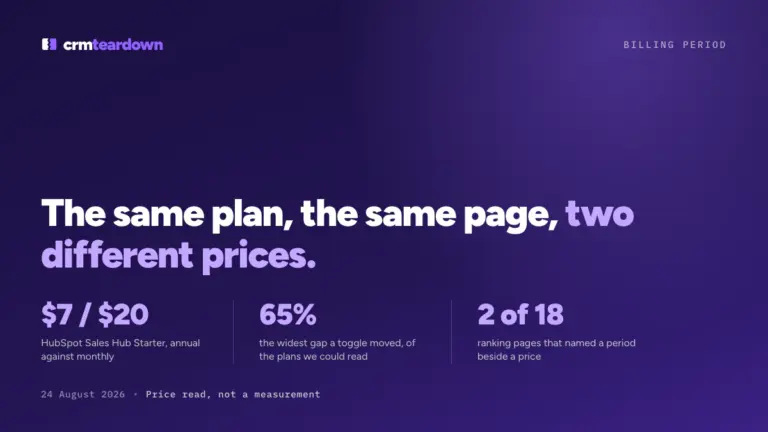
Usually the discounted commitment. Read on 24 August 2026, EngageBay's lowest figures are two-year rates, Freshsales published annual figures only on the page we read, and HubSpot Sales Hub Starter is $7 per seat on annual commitment against $20 paying monthly. Always find the toggle before you compare two vendors.
Which pricing model punishes a small team with a big contact list?
The hybrid: a per-seat price with contact tiers attached. The contact tier is bought once per seat, so a 12,000-contact list moved EngageBay's rate from $12.74 to $101.99 per user, and both of a two-person team's seats pay it.