Last updated 24 October 2026. This is a standing page. It is revised whenever a product moves on or off the list.
The CRMs we have not tested include Salesforce beyond a trial, Copper, Capsule, Nutshell, Keap, Attio and folk, along with most of the several hundred other products sold in this category. None of them will appear here as a review, a ranking or a "best for" pick, because nobody on this site has bought a seat, entered a deal or received an invoice from them. Where one of them is named at all, it is named as a fact read on the vendor's own page and dated, labeled research rather than measurement. Absence from the tested list is not a verdict on the product. It means we have no evidence, and a page built on no evidence is the thing this site exists not to publish.
Which CRMs have we not tested, and why?
These are the products readers ask about most often, and the ones a conventional roundup would rank without touching.
| Product | Why it is not reviewed here |
|---|---|
| Salesforce, beyond a trial | Named in comparison pages because readers arrive asking about it, but we have never run a paid org. Nothing here describes living in Sales Cloud. |
| Copper, Capsule, Nutshell, Attio and folk | Not in the test set. We have bought no seat, run no pipeline and received no bill for any of the five. |
| Keap | Not in the test set, and its automation and commerce layers would need their own run to describe honestly. |
| Every other CRM not named on our methods page | Not in the test set. The category runs to hundreds of products and no small site can run them all. |
The table is not exhaustive and cannot be. Anything outside the measurement program is untested here, which is the whole of it. And "untested" is a statement about us, not about the software: Copper has customers who are happy with it. We simply have nothing to add to that, and saying so costs less than pretending otherwise.
What counts as tested, and what the program covers
The products inside the measurement program are the ones the site's protocols are written for: HubSpot, Pipedrive, Zoho CRM Plus, monday CRM, Freshsales, Close, Brevo, EngageBay and Streak. That shortlist exists because it is what one operator can realistically buy, run in parallel and cancel, not because those nine are the nine best. Leadfeeder appears in the price index as a dated price read, which is research rather than a run, and it is not in the program.
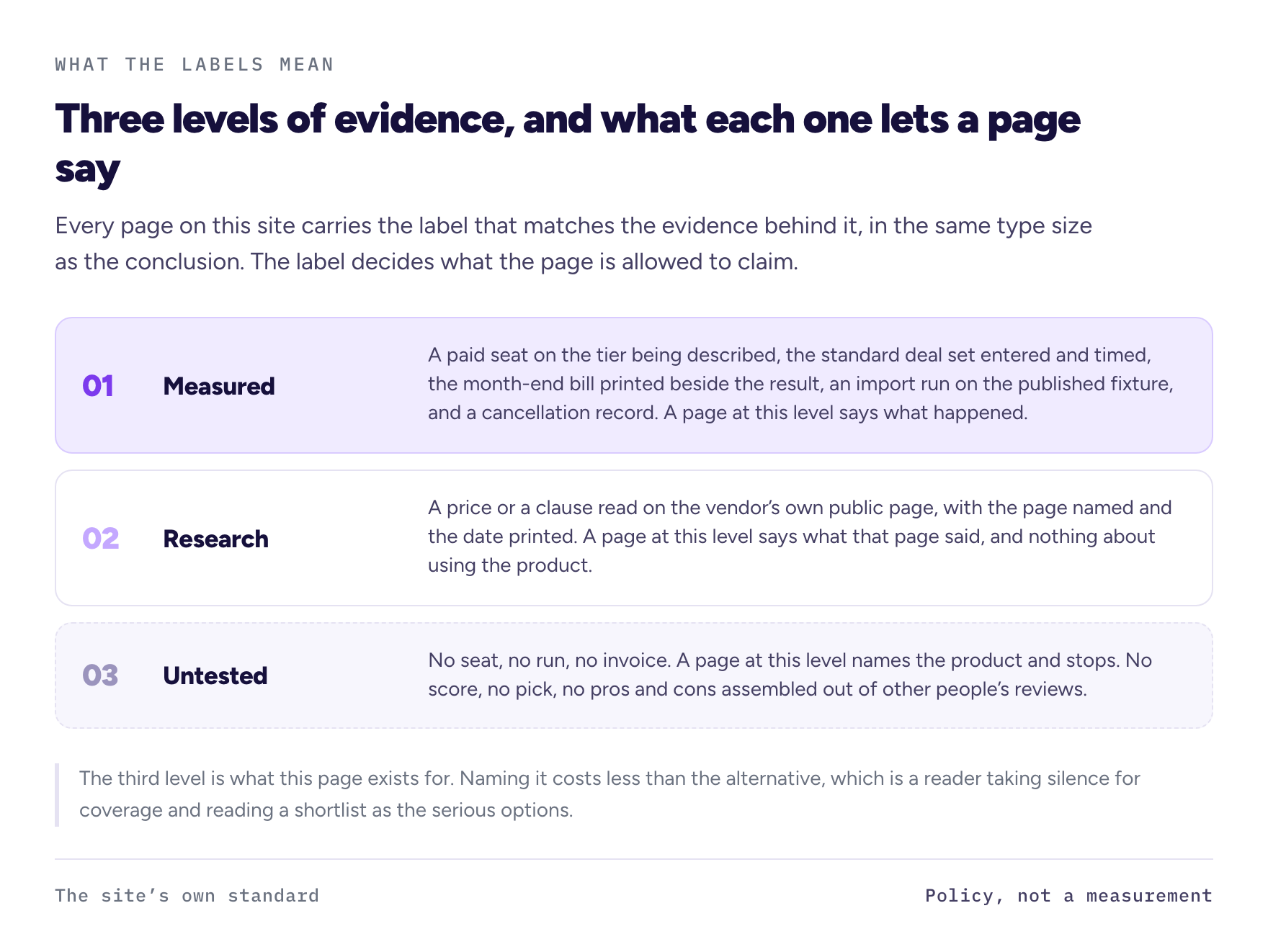
Being inside the program is not the same as having been run. The protocols, the sample sizes, the timer rules and the current state of each run are written out on our how we measure page, and every page on this site carries the label that matches its evidence: a measurement when a run produced the number, research when a published page did. That label sits in the same type size as the conclusion, not in a footer disclaimer. If you ever find a page here that reads as though a product was used when the label says research, that is a defect worth reporting rather than a style choice.
Why are untested CRMs not reviewed here?
An endorsement without experience is not allowed to sound like one. The Federal Trade Commission's guidance on endorsements is blunt about it: "You can't talk about your experience with a product if you haven't tried it," and an endorser cannot represent an experience level they do not have. A page that says "Attio is great for small teams" with no account behind it is making exactly that claim, whether or not the word "tested" appears anywhere on it.
Search guidance asks the same question a reader does. Google's own helpful-content documentation tells creators to be explicit about how the content was produced, including, for reviews, the number of products that were tested, what the results were and how the tests were conducted. A review that cannot answer those three questions is not a review. It is a rewrite of the vendor's feature list with a score attached.
The alternative is already everywhere. Search any "best CRM" query and the first page is largely built from vendor documentation, aggregated user ratings and feature grids. There is nothing wrong with a feature grid, but there are hundreds of them, and adding one more would make this site the eleventh copy of a page that already exists. The only thing here that is scarce is a record: a timer, an invoice, an import log, a cancellation. That record cannot be produced for a product nobody paid for.
What do we publish about the CRMs we have not tested?
Dated price reads. A vendor's published price is a checkable public fact, and reading it carefully is useful work, because the published figure is frequently not the figure a reader will pay. Our CRM price index records each plan with its billing period named and the date the page was read, and it says plainly where a tier is quote-only or where a page could not be read on the day. That is research. It is not a claim that anyone used the product.
Structural facts a reader can verify themselves. Whether a price is a monthly rate, an annual rate or a two-year commitment is visible on the vendor's page once you know to look, and the gap is often large enough to change the decision. The method for checking it, including which toggles and currency selectors to set, is in our note on whether that CRM price is monthly or annual, and it works on any vendor, including the ones on this page.
Nothing else. No star rating, no "our pick", no pros-and-cons list assembled from other people's reviews, no aggregated score. If a product is not in the program, there is no page here that tells you whether to buy it.
How can you evaluate a CRM we have not covered?
Run the same shape of check we would, on a smaller scale, for the one product you actually care about.
Start with the bill rather than the feature list. Our CRM total cost of ownership worksheet is pre-filled with the line items that sit outside the seat price, including per-organization charges, metered calling, document add-ons and credit packs, and you can complete it for any vendor by reading their own pricing and add-on pages with the billing toggle switched both ways. A product that looks cheapest on the headline seat often is not cheapest on the row that adds those up.
Then test the two things a trial can actually tell you: whether your data goes in, and whether the daily task takes a reasonable number of clicks. Import a real export of your contacts rather than a sample, and watch what the importer does with custom fields, multi-select values, notes, attachments and owner assignment. The failure modes are consistent across products and we have written up what breaks in a CRM migration so you know which ones to look for. Then enter five real deals and move them through your pipeline. Thirty minutes of that answers more than a week of comparison pages.
Finally, check what leaving costs before you arrive. Find the export function, confirm what formats it produces, confirm whether attachments and activity history come with it, and find the cancellation route in the account settings rather than in a help article. A product that makes any of those hard has told you something important about itself.
What would move a CRM from this list onto a tested page?
The bar is the same one every other page here is held to, and it is deliberately expensive:
- A paid seat on the tier being described, bought and paid for, with the invoice kept.
- The standard deal set entered and updated for the stated period, timed with the published timer rules.
- The month-end bill printed alongside the result, including anything metered.
- Where the page describes migration, an actual import run on the published fixture, with the failures logged rather than smoothed.
- A cancellation record, because what happens when you leave is part of what the product is.
Reader requests do influence what gets bought next, and a product being asked about often is a reasonable reason to spend money on it. What a request cannot do is shorten the list above.
What this page does not do
It does not rank the untested products, and it does not imply they are worse than the tested ones. It does not claim the nine products in the program are the nine that would win a fair evaluation of the whole category; they are the ones one budget can carry. And it does not promise that anything named here will ever be tested. If you need a verdict on Keap or folk today, this site is not where it is, and a site that handed you one on this evidence would be selling you a guess.
FAQ
Does "not tested" mean you think the product is bad?
No. It means no one here has used it, so there is no opinion worth printing. Several products on this list are well regarded by people who do use them.
Why name the untested CRMs at all instead of staying quiet?
Because the alternative is a reader assuming the silence is coverage. If a site publishes pages on nine vendors and says nothing about the rest, it is easy to read the tested shortlist as "the serious options". Naming the gap stops that, and it makes the shortlist's limits legible.
Can a vendor get its product added to the tested list?
A vendor can correct a factual error on any page here and the correction will be made and dated. What a vendor cannot do is buy inclusion, and products are paid for at list price rather than supplied, so there is no arrangement to offer. Free accounts or extended trials do not change the list either, because a plan that was not paid for does not produce the invoice the pages are built on.
You mention Salesforce in comparisons. Is that not reviewing it?
It is comparing published facts and naming where our evidence stops. A comparison page that uses Salesforce's documented pricing and setup requirements is doing the same work as the price index, with the same label. It is not describing what running a Salesforce org feels like, because that would require having run one.
How often does this page change?
Whenever a product moves onto or off the list, and at minimum whenever the measurement program's shortlist changes. The date at the top is the last revision. If it looks stale against the rest of the site, treat the methods page as the authority on what has actually been run.